ORPH-VAL WORKING GROUP


ORPH-VAL PAPER
Recommendations for value assessment and funding process in rare diseases
9 Principles covering recommendations on pricing and reimbursement decision criteria, pricing and reimbursement decision processes, sustainable funding systems and European coordination
Access Full paperOverview of Principles
Nine principles grouped into four themes have been developed by the Working Group
1. pricing and reimbursement decision criteria
Defining the elements of value and other considerations that are relevant to the pricing and reimbursement decision for OMPs.
2. pricing and reimbursement decision processes
Minimising decision uncertainty by systematically incorporating rare disease expertise and utilising adaptive assessment processes.
3. Sustainable funding systems
Defining the mechanisms of funding for OMPs to ensure long-term sustainability and equity of funding.
4. European collaboration
Pursuing greater co-ordination of OMP value assessment processes at a European level.
THE PRINCIPLES
Principles on OMP decision criteria
Principle 1: OMP assessment should consider all relevant elements of product value for OMPs in an appropriate multi-dimensional framework
- Decision-makers should consider OMP value from the perspective of patients, the healthcare system and wider society
- While the choice of value elements that are used to assess OMPs should be country specific, the Working Group has proposed a set of core elements that should be common to all health systems
- HTA agencies and payers should make explicit which elements of value they prioritise, how the rarity of a disease influences their assessment, and how societal preferences are incorporated into their decisions
Principle 2: Pricing and reimbursement decisions should be founded on the assessment of OMP value and adjusted to reflect other considerations beyond product value
- Reimbursement decisions should be based on the product value delivered by an OMP as described in Principle 1
- The price should, among other elements, be informed by considering the magnitude of the product value in light of price-value precedents for other specialist technologies and medicines
- P&R decisions should reflect the value that the EU attributes to OMPs through the incentives put in place to develop them
- Beyond OMP value, P&R status should be modulated to reflect other considerations, such as societal preferences, rarity, budget impact and sustainability of innovation in rare diseases
- In countries where cost-effectiveness is applied to assess value for money, the incremental cost-effectiveness ratio (ICER) thresholds should be modulated to reflect:
- all specificities of rare diseases (including rarity, unmet therapeutic need and societal preferences)
- the need to maintain innovation in rare diseases
- P&R decisions should aim at contributing to the right balance between allowing sufficient revenue generation to incentivise new research investment in rare diseases and attract private funders, while maximising value for money for healthcare systems
Principles on OMP decision process
Principle 3: Those making pricing and reimbursement decisions about OMPs at a national level should take account of all official regulatory and health technology assessments of OMPs undertaken at the European level
- Decision-makers should consider OMP value from the perspective of patients, the healthcare system and wider society
- While the choice of value elements that are used to assess OMPs should be country specific, the Working Group has proposed a set of core elements that should be common to all health systems
- HTA agencies and payers should make explicit which elements of value they prioritise, how the rarity of a disease influences their assessment, and how societal preferences are incorporated into their decisions
Principle 4: The assessment and appraisal of OMPs to inform national pricing and reimbursement decisions should incorporate rare disease expertise including both the healthcare professionals’ and patients’ perspectives
- HCPs and patients and their carers should be involved in the value assessment in the following ways:
- Disease-specific expert physicians (and other relevant academic specialists) should be involved from scoping of an assessment through to appraisal determination by the bodies that assess and appraise OMP
- Systematic representation of patient associations in meetings that assess and appraise OMPs
- Disease-specific patient representatives should be involved throughout the process and given appropriate training and support to contribute fully
Principle 5: To accommodate uncertainty, value assessment and pricing and reimbursement decisions should be adaptive subject to the need and availability of information over time.
- Given the nature of rare diseases, there is inherent uncertainty around all elements of product value. When assessing value, payers should consider this uncertainty in light of:
- disease prevalence
- disease severity and unmet need
- amount of prior research conducted in the disease
- extent to which the manufacturer has taken reasonable steps to minimise uncertainty
- To account for clinical and economic uncertainty, value assessment processes need to be adaptive (i.e. contingent), where necessary, and continuous rather than binary at the point of launch
- Pricing and reimbursement decisions should allow movement both up and down with newly generated evidence on value
- Where adaptive processes are required, all parties (payers, HTA agencies, involved HCPs, patients and industry) need to agree on this iterative process and clearly document the following:
- the evidence required and milestones for each step of the assessment
- the implications of not meeting the requirements and expectations initially agreed
- each stakeholder’s shared responsibility to collect and evaluate the data
- Where possible, the collection and analysis of real-world data should be co-ordinated at a European or international level and should be integrated in disease level registries and databases:
- obtain more European consistency in the continuous assessment and appraisal of OMPs
- to collect data on the true prevalence of a given rare disease in order to minimise financial uncertainty for payers
Principle 6: All eligible patients within the authorised label of an OMP should be considered in the national pricing and reimbursement decision although different decisions on access may apply to different sub-populations
- Wherever possible, reimbursement decisions should seek to ensure that all patients specified in the product marketing authorisation should receive access to treatment
- Reimbursement may be reflective of situations where there is a broad spectrum of disease and clearly defined patient subgroups in which OMP value substantially differs
Principles on OMP sustainable funding systems
Principle 7: Funding should be provided at the national level to ensure patient access to OMPs
- Funding for OMPs should be co-ordinated at a national level in order to avoid disparities in access between regions and to pool the financial risk of irregular distribution of patients
- Regional and local funding bodies should liaise and cooperate with national authorities to avoid inconsistencies and inequalities in regional access
- It is preferable that funding for OMPs should come out of normal healthcare budgets rather than from ear-marked rare disease funds that do not allow for a long-term perspective
Principle 8: Evidence-based funding mechanisms should be developed to guarantee long-term sustainability
- Manufacturers, payers and HTA agencies should collaborate nationally to improve forecasting and cooperate at the European level for horizon scanning with the aim of helping budget holders predict and plan for expenditure and ensure adequate funding of OMPs
- Early stage dialogue should occur between all stakeholders to ensure long term sustainability of outcomes
Principles on OMP European co-ordination
Principle 9: In the future there should be greater co-ordination of OMP value assessment processes at a European level
- While recognising that the reality today is one of national level competence, there is potential for a greater role for co-ordination of certain elements of value assessment in the future at EU level
- Rationales for collaboration between EU Member States on value assessment could include:
- Guarantee more consistency between Member States in the definition and assessment of clinical value
- Greater concentration of clinical expertise
- Pooling of data on epidemiology
- Opportunities for more systematic collection and assessment of data
- Reduced duplication of effort at the national level in the re-assessment of value and as such, faster access to medicines for patients
- In order to co-ordinate efforts, Member States should increasingly collaborate and share their knowledge in preparation for local evidence appraisals
- A co-ordinated mechanism should be put in place at the European level to help reduce evidential uncertainties around OMPs and enable rapid and continuous data collection post launch
Guide to core elements of value
Orphan medicinal product value |
||||||||||||
Impact of disease on |
Impact of treatment on |
|||||||||||
PATIENT LEVEL |
Survival/life expectancy
| |||||||||||
Healthcare system level |
Healthcare system resources and budget |
|||||||||||
Societal level |
Family/Carer quality of life |
|||||||||||
Considerations beyond OMP value | ||||||||||||
|
||||||||||||
Uncertainty of OMP value | ||||||||||||
|
||||||||||||
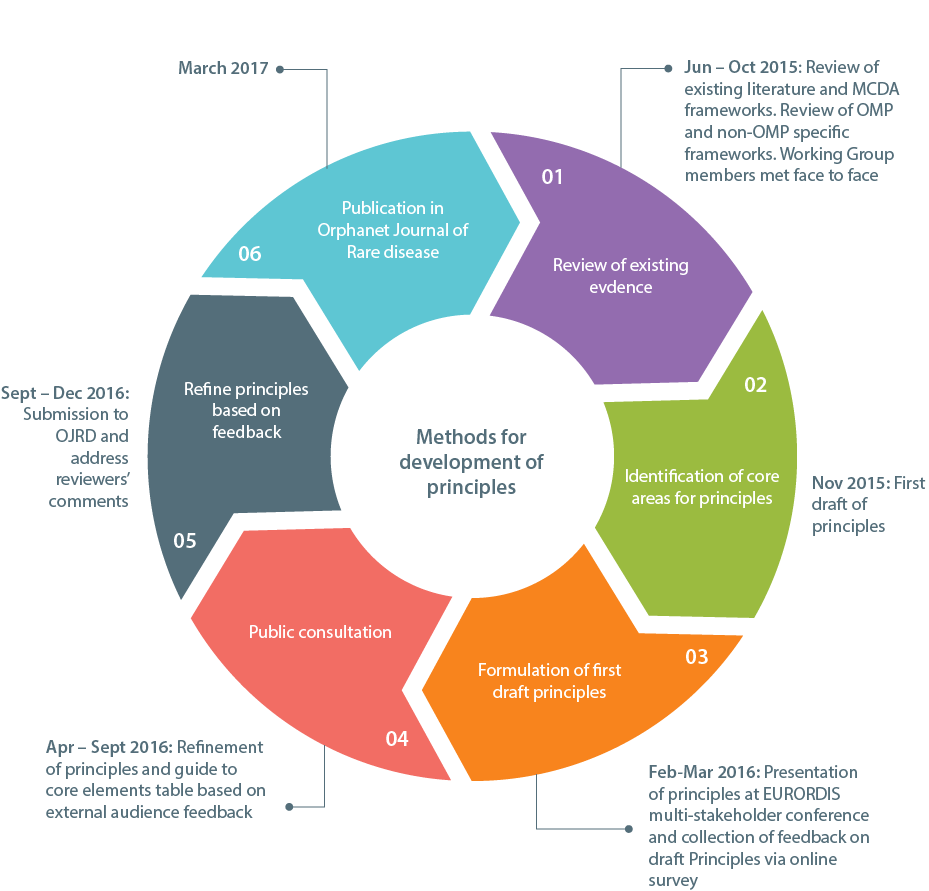
Development of the principles